Leveraging window-pane analysis with environmental factor loadings of genotype-by-environment interaction to identify high-resolution weather-based variables associated with plant disease
Abstract
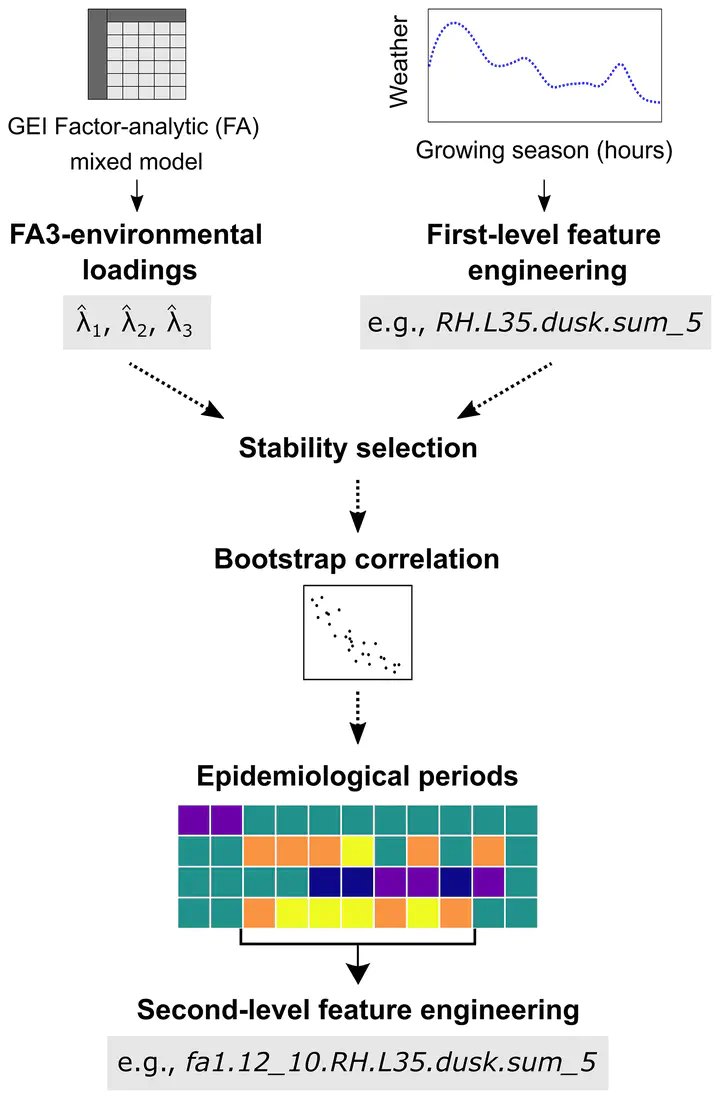
Designing and identifying biologically meaningful weather-based predictors of plant disease is challenging due to the temporal variability of conducive conditions and interdependence of weather factors. Confounding effects of plant genotype further obscure true environmental signals within observed disease responses. To address these limitations, this study leveraged window-pane analysis with feature engineering and stability selection to identify weather-based variables associated with latent environmental factors (λ) of a factor analytic model explaining genotype-by-environment (GEI) effects on disease severity in multi-environment trials. Using Stagonospora nodorum blotch of wheat as a case study and a two-stage feature engineering procedure, hourly weather data, including air temperature (T), precipitation (R), and relative humidity (RH), were aggregated into 1,530 distinct time series in the first stage. These series were correlated daily with λ throughout the second half of the wheat growing season. In the second stage, significant daily weather variables were consolidated into optimal epidemiological periods relative to wheat anthesis, yielding 60, 19, and 28 second-level weather-based variables derived from the first (λ₁), second (λ₂), and third (λ₃) environmental factor loadings, respectively. Among the weather-based predictors identified, fa1.41_18.TRH.13T16nRH.G80.daytime.sum_25 and fa1.11_5.R.S.dawn.sum_10 were positively associated with λ₁, the dominant environmental gradient underlying variation in SNB severity across environments, during pre-anthesis periods of 24 and 7 consecutive days, respectively. In contrast, fa1.22_16.TR.19T22nR.G0.2.dawn.sum_20 and fa1.2_12.RH.L35.daytime.sum_15 were negatively associated with λ₁ at pre-anthesis and post-anthesis, respectively. Additional predictors derived from T, R, and RH were identified up to 63 days pre-anthesis. However, no single predictor consistently maintained an association with λ during the entire study period. This framework advances the development of weather markers for detailed environmental profiling of GEI drivers and improves upon prior approaches that limited window-pane analysis to disease outcomes from susceptible hosts for identifying weather-based variables to predict plant disease epidemics.