Performance and stability of winter wheat cultivars to Stagonospora nodorum blotch epidemics in multi-environment trials
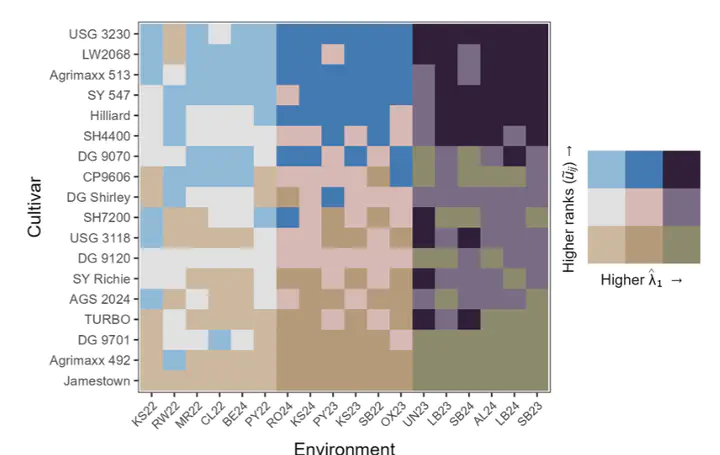 Factor-analytic linear mixed model analysis of winter wheat cultivar performance and stability to Stagonospora nodorum blotch across North Carolina environments.
Abstract
Field performance of winter wheat genotypes with quantitative resistance to Stagonospora nodorum blotch (SNB) is influenced by genotype-by-environment interactions (GEIs). This phenomenon explains why cultivars may perform inconsistently across environments, affecting decisions on locally adapted genotypes. Further, GEIs can also affect risk assessment when cultivar disease reaction is used as a model predictor under the assumption of stable responses across environments. Thus, this study investigated GEI effects on four disease metrics — final disease severity (SEV), relative area under disease progress stairs (rAUDPS), time to 50% disease incidence (T50), and the apparent rate of disease increase (ω) — describing SNB epidemics of 18 commercial soft red winter wheat cultivars planted in 18 environments in North Carolina from 2021 to 2024. Linear mixed models with various variance-covariance structures for random effects were used to analyze the disease data, and a third-order factor analytic model provided the best fit to the data across the metrics examined. Type B genetic correlation, broad-sense heritability, overall cultivar performance (OP), and global stability (expressed as root mean square deviation [RMSD]) were estimated using model outputs and the factor analytic selection tool method. For SEV, rAUDPS, and T50, genetic correlations ranged from −0.15 to 0.99, with most environment pairs exhibiting high values, indicating agreement in cultivar rankings, although some low values revealed rank instability and non-crossover GEI. Based on OP and RMSD, ‘USG 3230’ was the top-performing and most stable cultivar, whereas ‘TURBO’ and ‘SH7200’ were more unstable cultivars. Cultivar reaction classes derived from OP exhibited consistent class-level means of marginal predictions across environments with varying GEIs, supporting their utility as indicators of SNB susceptibility in risk assessment models. However, the presence of minor non-crossover GEI effects suggests that incorporating environmental drivers of GEI into SNB risk models could enhance prediction accuracy.